Piece 12 of 13 · Code · c. 2000–2026 · 3 min read
Typeset.us
A thesis from the turn of the millennium, finished in 2026
The thesis was written at the turn of the millennium. It argued that typography on the web was structurally broken, that it would have to be rebuilt from the algorithmic foundations print had already established, and that this was likely to happen soon. The diagnosis was correct. The soon took a quarter century.
Three Teachers
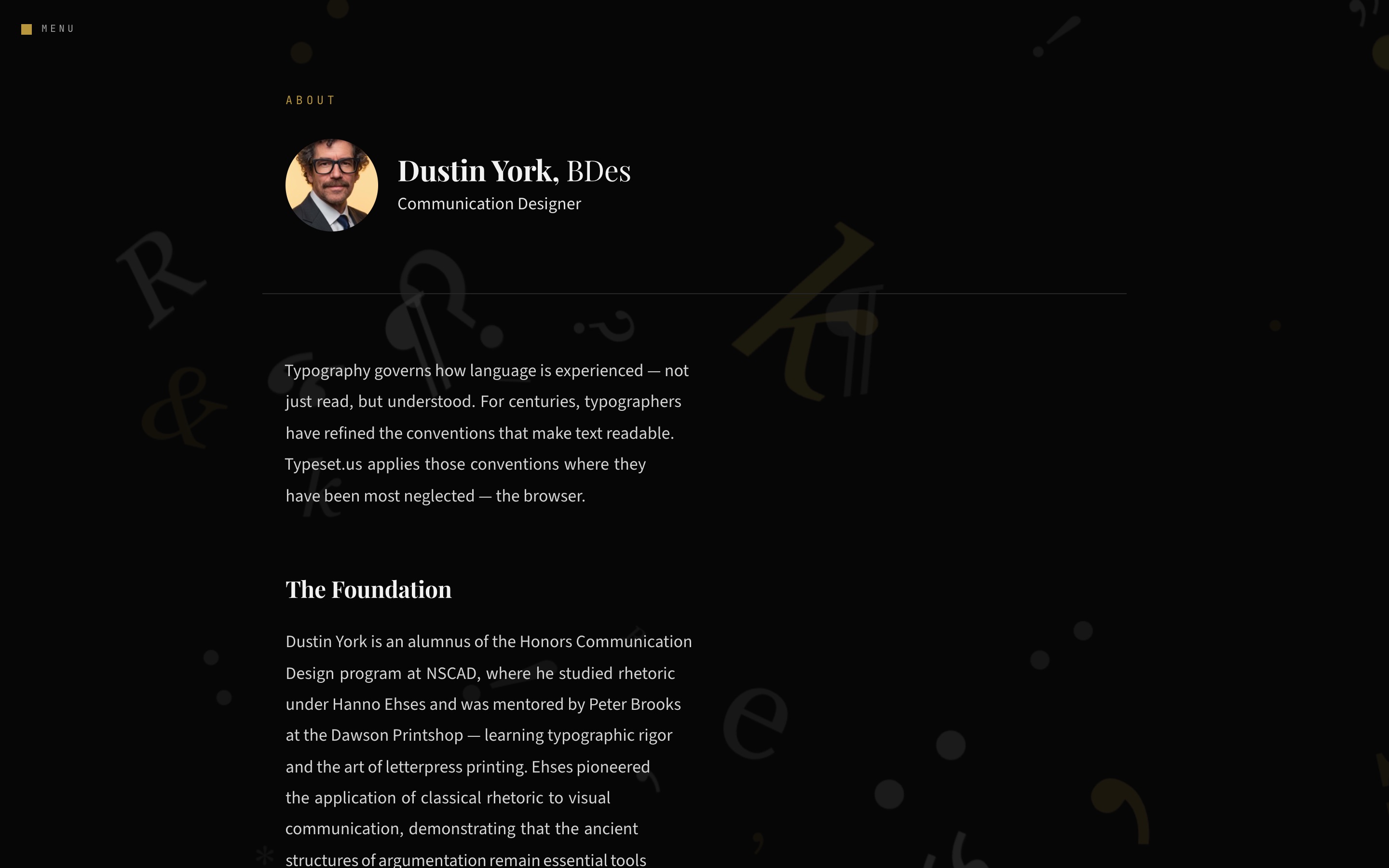
Peter Brooks ran the design print shop at NSCAD and taught the standard, the commitment to craft that does not relax when nobody is watching. He died in 2004; a bursary at the college still carries his name.
Hanno Ehses taught that design is argument and that classical rhetoric, figure, appeal, structure, is the underlying machinery of how arguments travel.
Ludwig Scharfe taught that the form is the argument too. Trained in Basel and Zurich under the masters of the Swiss tradition, he treated typography as something close to moral philosophy: a commitment to the reader that the page would not lie about its organization.
What Print Knew
Donald Knuth and Michael Plass published the canonical solution to line-breaking in 1981, a dynamic-programming algorithm that evaluates the paragraph in full, scores every possible configuration, and selects the global optimum. TeX uses it. InDesign uses it. The browser does not.
The browser greedily fills each line until the next word will not fit, then breaks. On narrow mobile measures, thirty-five characters, sometimes fewer, that algorithm produces rivers, staircases, orphans, and sentences split mid-thought. Every trained eye has suffered it. Every design meeting has made peace with it. The tools to fix it did not exist.
The browser, left to itself
A paragraph is not a column of words. It is an argument with a shape, and the shape is made of decisions: where a line ends, which words stay together, how even the rag is allowed to be. The browser makes none of those decisions. It runs out of room and stops.
- Lines
- –
- Orphaned last word
- –
- Lines ending on a weak word
- –
- Rag spread
- –
Greedy fill: it takes words until the next one will not fit.
Composed by typeset.us
A paragraph is not a column of words. It is an argument with a shape, and the shape is made of decisions: where a line ends, which words stay together, how even the rag is allowed to be. The browser makes none of those decisions. It runs out of room and stops.
- Lines
- –
- Orphaned last word
- –
- Lines ending on a weak word
- –
- Rag spread
- –
The whole paragraph is read before any line is broken.
The Tool
Dynamic programming over all plausible break configurations. Tschichold tolerances at eighty to one hundred and thirty-three percent of the natural word space. An anti-justification guard at ninety-two percent fill, because the rag is a feature, not a flaw. Syntactic break-quality rules that know prepositions, articles, and conjunctions should not end lines. Knuth and Plass for badness. Bringhurst for measure. Ruder for leading. No arbitrary constants. Every number traces to a published typographic authority.
What Broke First
The early implementations misread Tschichold. The i-width is a unit of measurement, not a tolerance range. Versions 1 through 3 used ±5.3px as the spacing range. Where the natural space is 4.3px, that produced a word-spacing: −5.3px , a negative gap of one full pixel. Words merged. Characters overlapped. The text was destroyed.
Three broken versions before the unit of measurement was correctly identified. Encoding a tradition looks, up close, exactly like that.
The Collaboration
Thirty years of recognizing broken type. No means of encoding the recognition into CSS and TypeScript. A language model, with the typographic literature available simultaneously, closed the gap. Neither the model nor the practitioner could have built the system alone.
There is precedent for this in typographic history under a different name. Tschichold had compositors. Knuth had Plass. Typographic achievements in the twentieth century were almost never one person’s work. What is new is that one of the collaborators is a machine, and its knowledge is available to anyone with a problem and a conversation.
What Arrived
The thesis predicted that better screens would solve the problem. The future that arrived is about cognition, a different kind of tool, able to understand the problem well enough to help solve it. The prediction was wrong in its specifics and right in its intuition. Typography on the web was always going to be solved by intelligence applied to structure. What kind of intelligence was the part that could not have been predicted.
Code · c. 2000 → 2026
“Encoding a tradition looks, up close, exactly like that.”